Better systems. Better outcomes. Better lives.

We exist to modernize the systems society depends on most.

Our mission focuses on transforming foundational critical infrastructure into adaptable, future-ready capabilities.

Mission Statement

Every improvement we make to a system has a human purpose. When processes run faster and more reliably, patients receive better care, communities stay safer, and public resources go further. We measure our work by the lives it improves.

Products

Steel Genetics

The clinical engine for hereditary-cancer genetics teams.

  • Streamlines clinical workflows in genetic counseling for inherited cancer risk. When a patient may carry a gene that raises their cancer risk, Steel builds their family tree, calculates their risk with established medical models, and drafts the clinical notes, test orders, and insurance paperwork, including appeals when an insurer denies coverage.
  • Turns test results into clear letters for patients and their relatives. Steel drafts plain-language letters explaining the results and recommended screening. For positive results, it also writes a letter for each relative who may share the gene, so families can get tested before cancer develops.
  • A human expert stays in charge, and every claim is traceable. Nothing reaches a patient until a genetic counselor reviews and approves it. Every medical statement is linked to its source, such as a clinical guideline, lab report, or the patient's family history.
Full description

Steel Genetics is a clinical software platform for hospital hereditary-cancer genetics programs that automates the drafting and paperwork around genetic counseling while keeping the counselor as the accountable decision-maker. It takes a patient from referral through recontact. It builds five-generation pedigrees from notes, spoken histories, recorded calls, or photos of hand-drawn charts, and checks them against 51 NCCN testing criteria. It runs validated risk models (Tyrer-Cuzick, CanRisk, PREMM5, BCRAT), each of which declines or cautions when a patient falls outside its validation.

It drafts counseling notes, test requisitions, medical-necessity letters, and insurance appeals built from payers' own eviCore guideline text. After testing, it reads lab reports, requires a ClinVar reclassification check before releasing any positive or VUS result, and produces plain-language disclosure letters with line-by-line source proofs. For positive results, it generates letters the patient can send to each at-risk relative to support cascade testing.

Every patient-facing letter requires counselor approval, enforced server-side, and counselor corrections become permanent regression tests. The platform also includes a cited guideline reference desk, an oncology workspace that flags tumor findings needing germline follow-up, a findings registry with reclassification sweeps, and a referring-physician portal, all hosted in a dedicated AWS environment.
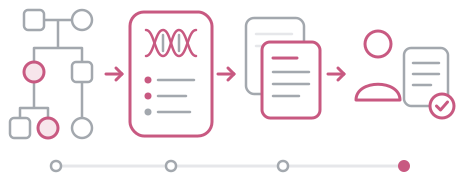
Steel Genetics workflow showing family history organized into hereditary-cancer risk analysis, clinical documentation, and clinician-reviewed results

Sentinel

School emergency notification and accountability, built to reach responders.

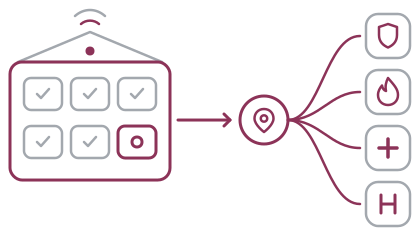
  • Silent emergency alerts from any teacher's phone. In a crisis, any staff member can raise a silent alert in two taps, even without a signal (it sends as soon as the connection returns). Once the front office confirms it, police, fire, EMS, and the local hospital emergency department are all notified at the same time.
  • Knows who is safe and who is missing. The system connects to the school's student records and class schedules, so during an emergency it tracks every room and every student. Each classroom gets its own instruction (such as lockdown or evacuate), and any room that hasn't checked in is clearly flagged so responders know where to look first.
  • One shared map for everyone responding. Police, fire, and EMS see the same live campus map, including 3D models of the buildings, showing where the incident is and where units are staged. Student records stay private with the school, and practice drills never reach responders or hospitals.
Full description

Sentinel is a school emergency alert and accountability system. Any staff member can send a silent alert from their own phone in two taps. The alert is saved on the device and sent as soon as the signal returns. Once an administrator confirms it, every staff device, the district office, police, fire, EMS, and the local emergency department are all notified at the same time and share a campus map built from Knotworks' own drone-captured 3D building models. The system pulls rosters, bell schedules, and guardian records from the district's student information system, so it can track accountability student by student and flag any room that hasn't been reported.

Each classroom gets its own instruction in the district's terms (hold, secure, lockdown, evacuate, shelter). Responders see only the incident details, not student records. Beyond emergencies, it handles visitor screening against the school's own list and a federal wanted list, verified release of students to guardians, first-aid guidance, and drill logging that assembles Pennsylvania's state certification paperwork. It runs in the browser on existing phones and computers with no new hardware.

Sentinel workflow showing a school alert shared with police, fire, EMS, and the hospital through one campus map, with classroom accountability

Rampart

EMS documentation and workflow automation, built by the emergency physicians who receive the patient.

  • It's a digital record-keeping app for ambulance crews. Paramedics use it on an iPad to document the care they give each patient during an emergency call. It saves everything on the device itself, so no information is lost even if the crew loses cell signal mid-call.
  • It warns the hospital before the ambulance arrives, and reports back to the crew afterward. While the ambulance is on its way, the app sends the emergency room the patient's vital signs, the medications given, and an arrival time, so staff can be ready. After the hospital treats the patient, it sends the outcome back, so the paramedics learn what happened to the person they helped, which they usually never find out.
  • It handles the paperwork and coordination so crews can focus on patients. It automatically fills out required state forms, formats records the way states require, and lets crews scan IDs or photograph equipment screens instead of typing. During large emergencies, it can sort multiple patients by severity and share a live map with police and fire departments.
Full description

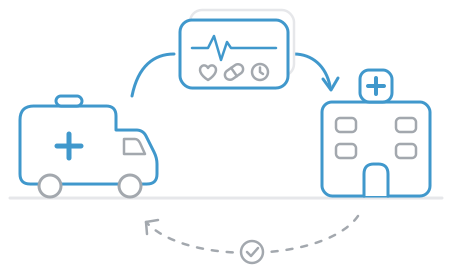
Rampart is an EMS documentation and workflow automation platform that links both ends of the ambulance to hospital handoff. Medics chart on the device first, so nothing is lost when signal drops, and the app syncs automatically once signal returns. While the truck is still en route, a pre-arrival card with vitals, medications, ECG interpretation, and ETA goes to the receiving emergency department. Afterward, the ED sends the patient's outcome back to the crew's own run record.

Its other features include a hands-free code timer, auto-filling of Pennsylvania's Transfer of Care form, license and monitor scanning that the medic confirms, an MCI triage mode that works without signal, a supervisor/QI dashboard, a county command map shared with police and fire, one-tap lights-and-siren justification required before a chart can be signed, and NEMSIS 3.5 export for state reporting.

Rampart workflow showing EMS patient information sent from an ambulance to a receiving hospital with outcome feedback returned to the crew

BlueQuill

Police documentation and records, from the officer's own words to court-ready paperwork.

  • It writes the police report for the officer. The officer types or uploads their account of what happened, and BlueQuill turns it into a properly formatted legal narrative and fills in the department's actual paperwork, asking specific follow-up questions where information is missing instead of making anything up.
  • It stress-tests the report before court. A built-in "mock trial" has simulated prosecutor, defense, and judge roles that examine the report apart and flag weak spots, so problems get fixed before a real defense attorney finds them.
  • It keeps a clear record of who wrote what. The AI's original draft is saved separately from the officer's edits, and every sentence in the final report is linked to the fact that supports it, so if a court asks which parts the machine wrote, there's a document that shows exactly that.
Full description

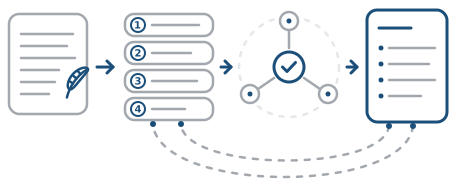
BlueQuill is a police documentation tool that turns an officer's own account of an incident into a court-ready report and the department's actual PDF forms, already filled in. It breaks the account into a numbered set of facts, asks targeted questions tied to specific form fields, and marks missing information. It never invents facts, statutes, or additional charges.

Before submission, its CrossCheck feature runs a mock trial in which simulated prosecutor, defense, and judge roles challenge the report and return a punch list of issues.

For accountability, it seals the machine's first draft, stores the officer's edits separately under their verified identity, and produces a printable redline and proof ledger tracing every sentence to its supporting fact. It also includes supervisor review queues, prosecutor referral, compliance reporting, and records retention.

BlueQuill workflow showing an officer narrative organized into structured facts, reviewed through CrossCheck, and transformed into a traceable final report

Team

  • Michael Morris, Chief Executive Officer

    Michael Morris

    Chief Executive Officer

  • Christopher Schwartz, Chief Operating Officer

    Christopher Schwartz

    Chief Operating Officer

  • David F Koziel, Jr, Chief Technology Officer

    David F Koziel, Jr

    Chief Technology Officer

  • Kelly Schuitema, Executive Vice President

    Kelly Schuitema

    Executive Vice President

  • Darrell McKnight, Senior Engineer

    Darrell McKnight

    Senior Engineer

  • Rawan Saed, Senior Engineer

    Rawan Saed

    Senior Engineer

  • Basil Damra, Specialist Engineer

    Basil Damra

    Specialist Engineer

Our team brings together physicians, industry experts, and engineers who share a common conviction: the systems society depends on deserves better technology. Our leadership is grounded in clinical practice, giving us firsthand understanding of the pressures faced by those who care for patients and protect communities.

That perspective is matched by deep expertise with a talented engineering team with the skill to turn complex challenges into reliable, intelligent software. Together, we combine real-world experience with technical excellence, building platforms shaped by the people who know these systems best and dedicated to serving the public good.

Our Methodology

  1. Across medicine, genetics, healthcare, public infrastructure, and emergency response, critical work is still slowed by outdated processes, fragmented data, and tools that were never built for today's demands.

  2. We build intelligent software platforms that learn, adapt, and automate, so clinicians can focus on patients, researchers can move discoveries forward faster, public servants can keep communities running, and first responders can act with speed and certainty when every second counts.

  3. As a Public Benefit Corporation, we measure our success not only by growth, but by the lives improved, the time returned to those who serve, and the trust we earn by building technology that is secure, transparent, and accountable to the public good.